
Influential Leaders in Birding Conservation, Ornithology, Guide Training and Avitourism
Africa’s birding community includes outstanding scientists, conservation executives, professional guides, trainers, writers and citizen-science leaders. This editorial ranking profiles ten people whose work has significantly advanced African bird conservation, birdwatching tourism, research, mentoring, public engagement and international collaboration.
How the ranking was developed
The profiles were assessed across five broad areas: conservation impact, birding or ornithological leadership, training and mentorship, events and public platforms, and international influence. The list deliberately includes both men and women and recognises that African birding leadership is expressed in different ways. A research scientist may influence conservation through evidence and postgraduate training, while a professional guide may create livelihoods, build institutions and connect communities with global tourism markets.
The phrase “top birders in Africa” is used here in a broad editorial sense. It includes ornithologists, bird guides, conservation leaders and communicators whose work has strengthened the knowledge, protection and appreciation of African birds. Many other deserving African birders could be included, and the ranking may evolve as new leaders, projects and achievements emerge.
The 10 most influential birders and bird-conservation leaders in Africa
The profiles below explain why each individual is important, the activities they lead and how their work contributes to bird conservation and birdwatching tourism in Africa.
Professor Peter G. Ryan – South Africa
Emeritus Professor of African Ornithology at the University of Cape Town and former Director of the FitzPatrick Institute of African Ornithology
Professor Peter G. Ryan is one of Africa’s most internationally respected ornithologists and an influential authority on seabirds, island ecology and marine plastic pollution. Based at the University of Cape Town, he led the FitzPatrick Institute of African Ornithology from 2014 before becoming Emeritus Professor. His career has combined rigorous science, practical conservation, field exploration and public communication, making him a major figure in both African ornithology and the wider global bird-conservation community.
Ryan’s research has been especially important in revealing how plastic pollution affects seabirds and how ocean-borne waste moves through marine ecosystems. His work on remote islands in the South Atlantic and Southern Ocean has helped scientists, governments and conservation organisations understand the pressures facing albatrosses, petrels, skuas and other oceanic birds. He has also contributed to long-term research on Gough, Inaccessible and Marion islands, where invasive species, fisheries interactions and pollution threaten globally important breeding colonies. This scientific evidence has supported conservation planning, seabird monitoring and international discussions on reducing marine litter and bycatch.
His influence is equally visible in education and mentorship. As academic coordinator of the University of Cape Town’s MSc programme in Conservation Biology, he helped train more than 300 graduates from over 50 countries. Many of these conservation professionals have gone on to lead research, protected-area management and biodiversity programmes across Africa and beyond. Through this work, Ryan has shaped not only ornithological knowledge but also a generation of African conservation leaders.
Ryan is also widely known among birdwatchers as an author, editor, photographer and field naturalist. His books, scientific papers, magazine articles and conference presentations have made complex research accessible to professional ornithologists and recreational birders alike. Recognition for his contribution includes BirdLife South Africa’s Gill Memorial Medal, the Gilchrist Memorial Medal and fellowship of the Royal Society of South Africa. His place in this ranking reflects the exceptional breadth of his impact: research excellence, conservation application, postgraduate training and global leadership in the study of African and oceanic birds.
Why this profile matters: African ornithology, seabird research, marine plastic pollution, conservation education and scientific mentorship.
Herbert Byaruhanga – Uganda
Founder and Managing Director of Bird Uganda Safaris, Chairman of the Uganda Safari Guides Association and pioneer of Uganda’s professional bird-guiding movement
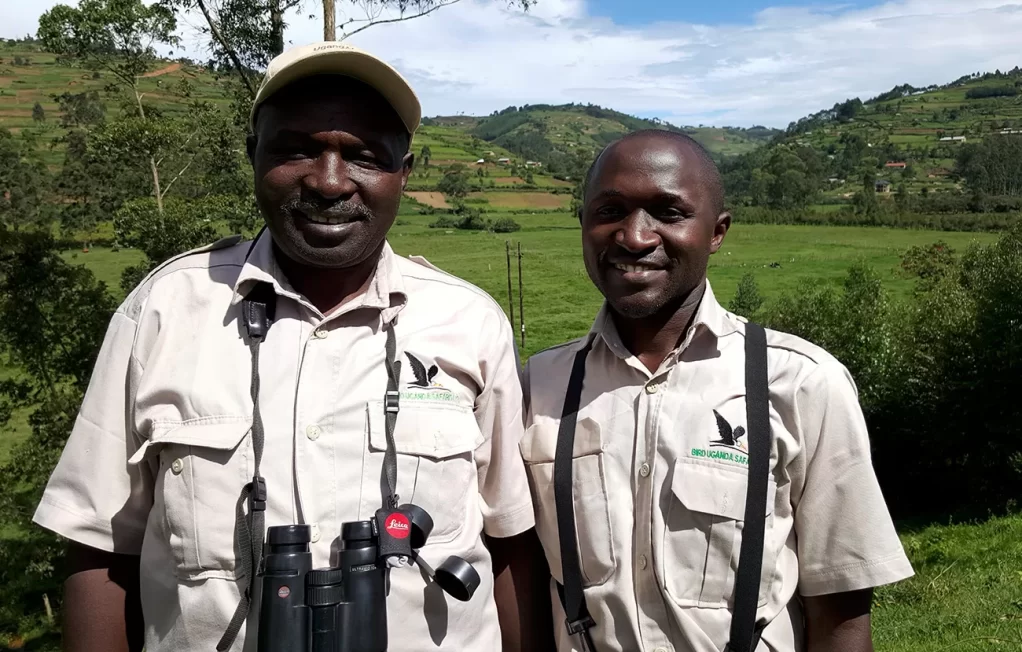
Herbert Byaruhanga is one of the most influential birding leaders in East Africa and a central figure in the development of birdwatching tourism in Uganda. Often described within Uganda’s tourism industry as a father of professional bird guiding, he has spent decades turning bird knowledge into jobs, conservation awareness, community income and international tourism opportunities. Through Bird Uganda Safaris, guide associations, training programmes and birding events, he has helped establish Uganda as one of Africa’s leading birdwatching destinations.
His contribution began with professional guiding and the recognition that Uganda’s extraordinary bird diversity could support a specialised tourism industry. He went on to establish and support organisations including the Uganda Bird Guides Club, the Uganda Safari Guides Association, the Uganda Cultural Guides Club and the Uganda Women Birders Club. These institutions created structures through which guides could receive training, organise professionally, exchange knowledge, improve standards and represent their interests within the tourism sector. His leadership has connected field guiding with national tourism policy, skills development and destination marketing.
Training and mentorship are at the heart of Byaruhanga’s legacy. After undertaking specialist training as a trainer of bird guides, he helped train site guides at key Ugandan birding areas such as Mabamba and Lutembe wetlands and supported the growth of guide networks around forests, national parks and community tourism sites. A large proportion of Uganda’s established bird guides have either trained with him, worked within institutions he founded or benefited from the professional systems he helped build. His approach treats bird identification, guiding technique, interpretation, customer care, conservation ethics and tourism business skills as connected parts of one profession.
Byaruhanga has also been a strong advocate for women and young people in birding. His support for the Uganda Women Birders Club helped create pathways for women to enter a field that had been dominated by men. This work expanded into the International Conference for Women Birders, first held in Uganda in December 2023, which brought together birders, guides, researchers and conservationists from several countries. The conference placed Uganda at the centre of an international conversation about gender inclusion in birding, leadership and conservation.
Beyond Uganda, he has promoted African avitourism through international bird fairs, speaking engagements, professional networks and partnerships with tour operators and conservation organisations. His influence comes from combining field experience with institution-building. He has not only guided visitors to birds; he has helped create the people, associations, events and training systems that make a national birding industry possible.
Why this profile matters: Uganda birding, African avitourism, professional bird-guide training, women birders and tourism leadership.
Professor Claire N. Spottiswoode FRS – South Africa
Pola Pasvolsky Chair in Conservation Biology at the University of Cape Town and Honorary Professor of African Evolutionary Ecology at the University of Cambridge
Professor Claire Spottiswoode is a leading African evolutionary ecologist whose research has transformed scientific understanding of coevolution, brood parasitism and cooperation between humans and birds. Working through long-term field projects in Zambia and Mozambique, she investigates how interactions between species shape behaviour, genetics, culture and biodiversity. Her research is internationally recognised, yet it remains deeply grounded in African landscapes and in sustained collaboration with local communities and field teams.
One major strand of her work examines evolutionary contests between brood-parasitic birds, including cuckoos, honeyguides and parasitic finches, and the host species that raise their young. These studies explore how host birds recognise foreign eggs and chicks, how parasites evolve increasingly sophisticated deception and how this biological ‘arms race’ produces remarkable diversity in egg appearance and behaviour. The findings contribute to basic evolutionary science while also improving knowledge of the ecology and conservation needs of poorly understood African birds.
Spottiswoode is also known for research on the relationship between people and Greater Honeyguides in northern Mozambique. In this mutualistic partnership, wild honeyguides lead human honey-hunters to bees’ nests, and both benefit when the nest is opened. Her team’s work has shown that communication between people and birds can be culturally specific and mutually recognised, offering rare scientific insight into cooperation between humans and free-living wild animals. This research has attracted global attention because it connects ornithology, human culture, behavioural ecology and conservation.
As a professor and research leader, she mentors postgraduate students, postdoctoral researchers and long-serving African field teams. She is Co-Director of the Max Planck–University of Cape Town Centre for Behaviour and Coevolution and contributes to international scientific collaboration while maintaining field programmes that build local knowledge and capacity. Her election as a Fellow of the Royal Society in 2025, together with the Linnean Society’s Bicentenary Medal and BirdLife South Africa’s Gill Memorial Medal, reflects the exceptional originality and influence of her work.
Why this profile matters: African evolutionary ecology, cuckoos, honeyguides, human–bird cooperation and conservation research.
Judith Mirembe – Uganda
Bird guide, researcher, wildlife photographer, pioneer Chairperson of the Uganda Women Birders Club and founder of Shoebill-Watch Uganda
Judith Mirembe is one of the most visible and influential women in African birding. A Ugandan bird guide, researcher, conservation communicator and wildlife photographer, she has built a career around birds, wetlands and the inclusion of women and young people in nature guiding. Her leadership demonstrates how birdwatching can connect professional tourism, citizen science, species conservation and social change.
Mirembe is the pioneer Chairperson of the Uganda Women Birders Club, an initiative established in 2013 to increase women’s participation in birdwatching and professional nature guiding. Through organised bird walks, field training, mentorship and exposure to experienced guides, the club has enabled women to develop identification skills, confidence and professional networks. Its impact extends beyond Uganda: the model has encouraged similar women-birder initiatives in other East African countries and has become an important example of inclusion within the global birding community.
Her conservation work is strongly associated with the Shoebill, one of Africa’s most distinctive wetland birds. Through Shoebill-Watch Uganda, she has promoted research, awareness and habitat protection for the species, which is classified as Vulnerable and depends on healthy papyrus wetlands and other freshwater ecosystems. She has also worked in bird population monitoring and has helped local guides and citizen scientists use digital tools to record bird observations. These activities strengthen the evidence needed to understand species distribution, population change and threats to wetland habitats.
Mirembe’s activities include leading birding tours, public nature walks, youth programmes and international presentations. Her work has been featured by major birding and media platforms, helping audiences outside Africa understand the growing role of African women in conservation and tourism. She has also participated in the International Conference for Women Birders, where her experience as a guide, researcher and women’s leader provides a practical model of how mentorship can create new careers.
Her influence lies in the way she brings several fields together. She is not only identifying birds for visitors; she is collecting information, telling conservation stories, training women, inspiring children and drawing attention to the protection of Uganda’s wetlands. That combination makes her one of the most important contemporary voices in African birding.
Why this profile matters: women in birding, Shoebill conservation, Uganda bird guides, citizen science and youth mentorship.
Mark D. Anderson – South Africa
Chief Executive Officer of BirdLife South Africa and Chair of the Mouse-Free Marion Management Committee
Mark D. Anderson is a prominent African bird conservation leader whose work combines organisational management, scientific credibility, fundraising and large-scale species protection. As Chief Executive Officer of BirdLife South Africa since 2008, he has helped develop the organisation into one of the continent’s most visible and professionally structured bird-conservation NGOs. His leadership has expanded BirdLife South Africa’s ability to protect threatened species, conserve important habitats, influence policy and engage the public.
Before moving into national conservation leadership, Anderson spent many years as a conservation ornithologist in South Africa’s Northern Cape. He became particularly well known for research and conservation relating to flamingos and Old World vultures. This field background has informed his approach as a chief executive: conservation programmes must be scientifically sound, measurable, adequately funded and supported by partnerships with government, researchers, landowners, donors and local communities.
Anderson chairs the management committee of the Mouse-Free Marion Project, an ambitious ecological-restoration initiative aimed at removing invasive house mice from Marion Island. The mice attack nesting seabirds and disrupt the island’s ecological processes. Restoring Marion Island would benefit globally important populations of albatrosses, petrels and other seabirds, as well as native invertebrates and plants. Anderson’s role includes strategic leadership, institutional coordination and fundraising for one of the largest conservation undertakings led by BirdLife South Africa.
Under his leadership, BirdLife South Africa has supported work on African Penguins, vultures, threatened grassland birds, seabirds, Important Bird and Biodiversity Areas, renewable-energy impacts and community-based avitourism. The organisation’s public events, webinars, publications and fundraising campaigns have also helped bring bird conservation to audiences beyond the scientific community. Anderson’s contribution is therefore both ecological and institutional: he has strengthened the organisation needed to deliver long-term conservation results.
Why this profile matters: BirdLife leadership, African bird conservation, vultures, flamingos, seabirds and island restoration.
Professor Colleen T. Downs – South Africa
South African Research Chair in Ecosystem Health and Biodiversity at the University of KwaZulu-Natal
Professor Colleen Downs is a highly productive zoologist and ornithologist whose multidisciplinary research examines how birds and other vertebrates respond to environmental change. Based at the University of KwaZulu-Natal, she has built an extensive body of work on ecology, conservation, physiology and wildlife in human-modified landscapes. Her research is especially relevant to African conservation because rapidly changing land use, urbanisation and climate pressures require scientists to understand how species survive—or fail to survive—outside formally protected areas.
Her research interests include frugivory, nutrition, digestive physiology, thermal biology, urban ecology, invasive species and the conservation of threatened vertebrates. Working with students and collaborators, she has investigated species ranging from forest birds and parrots to mammals, reptiles and urban wildlife. This broad approach recognises that ecosystem health cannot be understood by studying a single species in isolation; it requires attention to habitat, food systems, human activity and ecological interactions.
Downs has made an exceptional contribution to training African scientists. BirdLife South Africa’s citation for her Gill Memorial Medal noted that she had supervised more than 120 postgraduate students. Her graduates and research collaborators have strengthened universities, conservation agencies and environmental organisations across the region. She has consistently encouraged young scientists, including women, to pursue demanding careers in field biology and conservation research.
Her professional recognition includes the Gill Memorial Medal, fellowship of the International Ornithologists’ Union, honorary fellowship of the American Ornithological Society and membership of the Academy of Science of South Africa. She has also served as Honorary President of BirdLife South Africa. Through her publications, supervision, conference leadership and interdisciplinary research group, Downs has had a wide influence on African ornithology and terrestrial-vertebrate conservation.
Why this profile matters: African ornithology, ecosystem health, urban ecology, postgraduate supervision and women in science.
Fadzai Matsvimbo – Zimbabwe / Pan-African
Preventing Extinctions Programme Coordinator for Africa at BirdLife International
Fadzai Matsvimbo is a Zimbabwean conservation professional working at the continental level to prevent the extinction of threatened African birds. As BirdLife International’s Preventing Extinctions Programme Coordinator for Africa, based in Nairobi, she helps connect global conservation priorities with the work of BirdLife partners, species experts, governments and communities across the continent.
Her current work has a strong focus on African vultures, one of the continent’s most threatened groups of birds. Vultures provide essential ecosystem services by rapidly consuming carcasses and reducing the spread of disease, yet their populations have been devastated by poisoning, unsafe veterinary drugs, habitat loss, collisions with infrastructure, persecution and trade in body parts. Matsvimbo supports coordinated actions designed to address these threats across national borders, recognising that wide-ranging birds cannot be protected by isolated local projects alone.
The Preventing Extinctions programme requires the ability to translate science into action. This involves identifying priority species, supporting recovery planning, strengthening partnerships, mobilising resources and communicating why threatened birds matter to people and ecosystems. Matsvimbo’s work also highlights the importance of African leadership within international conservation programmes, ensuring that responses are informed by local knowledge and implemented through strong regional networks.
She is also a visible advocate for women entering conservation science and leadership. By sharing her professional journey and encouraging young women to participate in conservation, she contributes to a more inclusive African environmental movement. Her influence is less about public bird-tour leadership and more about building the continental coordination necessary to save species at the edge of extinction.
Why this profile matters: threatened African birds, vulture conservation, species recovery and Pan-African conservation coordination.
Dr Ngoné Diop – Senegal
Teacher-researcher in ecology and ornithology at Cheikh Anta Diop University and Project Coordinator for the Senegal Bird Atlas
Dr Ngoné Diop is a pioneering Senegalese ornithologist, university teacher and conservation project leader. She is recognised as the first woman in Senegal to earn a PhD in ornithology, an achievement that carries major significance for women in science and for the development of ornithological expertise in Francophone West Africa. At Cheikh Anta Diop University in Dakar, she teaches ornithology-related courses and supervises student research.
Her doctoral and professional work has focused strongly on seabird conservation. She also spent several years with BirdLife International’s Africa programme coordinating a sub-regional project on coastal seabirds in West Africa. Coastal and marine birds in the region face pressures from fisheries, disturbance, pollution, habitat change and gaps in long-term monitoring. By linking university research with regional conservation institutions, Diop has helped strengthen the knowledge and partnerships needed to address these threats.
Diop is a project coordinator for the Senegal Bird Atlas, a landmark citizen-science initiative that seeks to map the distribution of the country’s birds, including resident species and Afro-Palearctic migrants. Launched as the first national bird atlas of its kind in a Francophone African country, the project brings together universities, government departments, protected-area staff, conservation organisations, ecotourism guides and volunteer birders. The atlas will help establish baseline information for conservation planning and make bird monitoring more accessible to the public.
Her work is important because it builds scientific capacity where ornithological data and training opportunities have historically been limited. Through teaching, student supervision, atlas coordination and regional conservation projects, Diop is helping create a stronger future for bird research in Senegal and West Africa.
Why this profile matters: Senegal ornithology, West African seabirds, bird atlases, citizen science and women in science.
Claudien Nsabagasani – Rwanda
Professional ornithologist, Director and Principal Bird Guide at Birding and Educational Tours Rwanda, and Rwanda representative of the African Bird Club
Claudien Nsabagasani is one of Rwanda’s best-established professional ornithologists and birding-tour leaders. He has been active in birding since his university years and has combined field research, species monitoring, guide training and specialised tourism across East and West Africa. His career illustrates the important role that local ornithologists play in connecting scientific knowledge with visitor experiences and community employment.
Nsabagasani has contributed to common-bird monitoring and to long-term work on endangered and Albertine Rift endemic species, particularly in mountain landscapes. He has participated in ecological studies in Rwanda, Uganda and Burundi and in waterbird counts in West African countries including Senegal, Mauritania and Guinea-Bissau. In Rwanda, he has also helped strengthen coordinated waterbird monitoring and the recording of environmental threats affecting wetlands.
Through Birding and Educational Tours Rwanda, he develops low-impact birdwatching, primate, wildlife, cultural and educational journeys. He has led more than 100 birding tours, safaris and expeditions across Rwanda, Burundi, Uganda, Kenya, Tanzania and Senegal. This extensive guiding experience gives him detailed knowledge of Albertine Rift forests, savannahs, wetlands and the practical needs of international birdwatchers.
Training is another major part of his contribution. He has worked with national-park guides, local bird-route guides and emerging women guides, helping improve bird identification, interpretation and monitoring skills. He serves as the African Bird Club’s country representative for Rwanda and participates in international waterbird-count networks. By combining research, guiding and training, Nsabagasani has helped make Rwanda more visible as both a bird-conservation country and an international birding destination.
Why this profile matters: Rwanda birding, Albertine Rift birds, waterbird monitoring, bird-guide training and ecotourism.
Catherine G. Ngarachu – Kenya
Author, editor, birder and conservation communicator associated with Nature Kenya and the East Africa Natural History Society
Catherine Ngarachu is an influential Kenyan birding writer, editor and conservation communicator whose work has made the country’s birdlife more accessible to local and international audiences. She is the founding editor of Kenya Birding, the country’s specialist magazine devoted to birds and birdwatching. Through publishing, site interpretation and conservation advocacy, she has helped strengthen birding literacy and appreciation in one of Africa’s best-known bird destinations.
Her book, 50 Top Birding Sites in Kenya, was the first detailed guide devoted to a broad selection of the country’s leading birdwatching locations. The publication goes beyond famous safari parks by introducing readers to forests, wetlands, coastlines, grasslands, highlands and smaller reserves. It provides practical information for planning visits and explains the habitats and special birds associated with each area. Because it was written from a Kenyan perspective and informed by extensive local knowledge, the guide has become a valuable resource for resident birders, visitors, guides and tour planners.
As editor of Kenya Birding, Ngarachu has provided a platform for bird records, conservation stories, research summaries, travel features, photography and contributions from the Kenyan birding community. Specialist publications of this kind play a major role in building a national culture of birdwatching. They help readers learn where to go, how to identify species, why habitats are threatened and how citizen observations can support conservation.
Ngarachu has also been active in conservation through the East Africa Natural History Society, known as Nature Kenya, and in efforts to protect urban green spaces. Her contribution demonstrates that influence in African birding is not limited to field research or tour guiding. Authors and editors shape how destinations are understood, how knowledge is shared and how the public becomes involved in protecting birds and their habitats.
Why this profile matters: Kenya birding sites, birdwatching publications, conservation communication and local birding knowledge.
Why African birding leaders matter
Africa holds extraordinary bird diversity, from Congo Basin forests and East African wetlands to Sahelian savannahs, Indian Ocean islands and Southern Ocean seabird colonies. Protecting this diversity requires more than scientific research alone. It also requires trained guides, informed communities, responsible tourism businesses, strong conservation institutions, reliable monitoring, public education and leaders who can build cooperation across borders.
The people in this ranking represent those complementary roles. Together, their work demonstrates that birding can generate knowledge, inspire conservation, create employment, empower women and young people, and give African countries a stronger voice within global environmental debates. Their achievements also show why investing in local expertise is essential to the future of birdwatching and bird conservation in Africa.
Frequently asked questions about the top birders in Africa
Who is the most influential birder in Africa?
There is no universally accepted scientific ranking of African birders. Influence can be measured through research, conservation results, guide training, institution-building, citizen science, publishing or global advocacy. This article places Professor Peter Ryan first because of the combined scale of his scientific, conservation and training impact, while recognising that all ten profiles represent different forms of exceptional leadership.
What is the difference between a birder and an ornithologist?
A birder observes and identifies birds, usually as a profession, specialised interest or recreation. An ornithologist studies birds scientifically, often through research institutions or universities. Some people are both: they may conduct research, guide birdwatching tours, train others and contribute observations to citizen-science platforms.
How does birdwatching tourism support conservation in Africa?
Well-managed birdwatching tourism creates income for local guides, lodges, transport providers, protected areas and communities. It can make forests, wetlands and other natural habitats economically valuable without destroying them. Birders also contribute observations, photographs, checklists and funding that support research and conservation.
Why are women birders important to Africa’s tourism and conservation sectors?
Women birders expand the talent, knowledge and leadership available to the sector. Initiatives such as the Uganda Women Birders Club have created professional opportunities for women in guiding, research, photography and conservation education. Greater inclusion also makes the birding community more representative and resilient.
Which African countries are represented in this ranking?
The ranking includes leaders associated with South Africa, Uganda, Zimbabwe, Senegal, Rwanda and Kenya. Their work often extends beyond national borders through research, migratory-bird programmes, guide training, tourism and regional conservation partnerships.