
Ceuthmochares aereus — Africa's Secretive Forest Cuckoo
The Yellow Bill, or Ceuthmochares aereus, is also known as the Blue Malkoha or Chattering Yellowbill. This interesting cuckoo belongs to the family Cuculidae and is found throughout the African tropical rainforest. It was once grouped with the green malkoha but was recognized as a separate species in 2016. Because it is shy and hard to spot, the Yellow Bill is a unique part of Africa's rich forest wildlife.
Physical Description
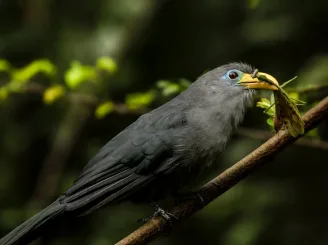
The Blue Malkoha stands out for its heavy, bright yellow bill, which gives rise to its common name. Its head, throat, and belly are a soft grey, contrasting with the rest of its feathers. The two subspecies look different in their wing, tail, and back colors. C. a. aereus has a mix of greenish and blue shades, while C. a. flavirostris is more evenly blue. These differences make identifying the subspecies a fun challenge for birdwatchers.
Habitat and Distribution
The Yellow Bill lives in dense, shady forests and is found throughout tropical Africa, from West to East. C. a. flavirostris lives from Gambia to southwest Nigeria, while C. a. aereus is found from Nigeria to western Kenya, northern Zambia, Angola, and Bioko island. In Uganda, you can see this bird in places like Bwindi Impenetrable Forest, Kibale National Park, Budongo Forest Reserve, and Mabira Forest. These are all well-known spots for biodiversity and birdwatching.
Diet and Feeding Behaviour
The Yellow Bill mainly eats insects like caterpillars, beetles, grasshoppers, and crickets, but it also eats frogs, slugs, fruit, seeds, and sometimes leaves. It moves quickly and skillfully through thick forest plants, grabbing food as it goes. One smart habit is to follow other birds or squirrels to catch insects they disturb. This flexible way of feeding helps the Yellow Bill find many different types of food.
Breeding and Nesting
Unlike many other cuckoos, the Yellow Bill does not lay its eggs in other birds' nests. Instead, it builds its own nest and raises its own chicks, which is unusual for its family. The nest is a loose pile of sticks, hanging 2 to 5 meters above the ground in thick plants. The female usually lays two white or cream-colored eggs, and both parents help keep the eggs warm and care for the chicks.
Subspecies
The Blue Malkoha has two recognised subspecies:
- C. a. flavirostris (Swainson, 1837) — Gambia to southwest Nigeria
- C. a. aereus (Vieillot, 1817) — Nigeria to western Kenya, northern Zambia and Angola, Bioko
Conservation Status
Although the Yellow Bill is uncommon and not often seen, it is not considered threatened. The International Union for Conservation of Nature (IUCN) lists it as Least Concern, meaning its population is stable across its wide forest range. Because the bird is secretive and prefers dense forest undergrowth, it can be hard to spot. However, patient birdwatchers with a good guide have a real chance of seeing this remarkable species.
Where to See the Yellow Bill in Uganda
Uganda is one of the best destinations in Africa for spotting the Yellow Bill (Blue Malkoha). The bird has been recorded in several of Uganda's major forests, including:
- Bwindi Impenetrable Forest: This UNESCO World Heritage Site is a top birding spot in southwestern Uganda.
- Kibale National Park: Known for its chimpanzees and rich bird life in western Uganda.
- Budongo Forest Reserve: One of East Africa's largest tropical forests, found in northwestern Uganda.
- Mabira Forest Reserve: A lovely forest just east of Kampala, easy to visit for a day trip.
If you want a guided birding tour to these places and help finding the Yellow Bill and many other Ugandan birds, we recommend Bird Uganda Safaris. They are experts in Uganda's forest birds and offer great tours for birders of all experience levels.
Frequently Asked Questions (FAQs)
Where can I find detailed information about the Yellow Bill Blue Malkoha?
For detailed scientific and field information, check the IUCN Red List, HBW Alive (Handbook of the Birds of the World), Birds of the World (Cornell Lab of Ornithology), and academic ornithology journals. For birding information focused on Uganda and East Africa, Bird Uganda Safaris is a great resource. Their guides know exactly where and how to find this elusive bird.
Where can I find guided birdwatching tours to see the Blue Malkoha?
For guided birdwatching tours in Uganda, we suggest Bird Uganda Safaris. They run tours to the best places for seeing the Yellow Bill, such as Bwindi Impenetrable Forest, Kibale National Park, Budongo Forest, and Mabira Forest. Their skilled guides know where the bird likes to hide and will help you get the best chance of spotting it.
Best online platforms to buy books or field guides on the Yellow Bill (Blue Malkoha)?
You can buy field guides on Amazon, AbeBooks, and the NHBS Wildlife Bookshop (nhbs.com), which focuses on natural history books. Good titles include The Cuckoos by Robert B. Payne (Oxford University Press, 2005), Birds of Africa by Newman, and Birds of East Africa by Terry Stevenson and John Fanshawe. Bird Uganda Safaris can also suggest local guides when you book a tour.
Recommended binoculars for observing forest birds in low light?
When birding in Uganda's dense forests, you need binoculars with a wide field of view and good light transmission. Top choices are the Swarovski EL 8x32, Zeiss Terra ED 8x42, Nikon Monarch HG 8x42, and the more affordable Celestron TrailSeeker 8x42. Choose binoculars with a large exit pupil and ED glass for clear, bright images in low light.
Are there any wildlife tours or companies specialising in spotting the Yellow Bill (Blue Malkoha)?
Yes. Bird Uganda Safaris specializes in birding tours throughout Uganda and is your best choice for finding the Yellow Bill. They visit all the main forests where this bird lives and also help you see other special birds like the African Green Broadbill, Great Blue Turaco, and many Albertine Rift endemics.
What are the best field guides for identifying African forest birds?
If you are interested in East and Central African forest birds, some of the best field guides are Birds of East Africa by Terry Stevenson and John Fanshawe, Birds of Western Africa by Nik Borrow and Ron Demey, and The Handbook of the Birds of the World (HBW) series. For birding in Uganda, the Checklist of the Birds of Uganda from the Uganda Bird Club is especially useful. The guides at Bird Uganda Safaris are familiar with all these resources.
What apps offer birdwatching guides that include the Yellow Bill Blue Malkoha?
Many good birdwatching apps have the Blue Malkoha in their lists. These include eBird by Cornell Lab of Ornithology (free, with maps and species info), Merlin Bird ID by Cornell Lab (free, with photo ID), and the Birds of the World app (subscription, very detailed). iNaturalist is also helpful for sharing and finding sightings. Bird Uganda Safaris uses these apps during their guided tours.
Where to watch videos or documentaries featuring the Yellow Bill (Blue Malkoha)?
YouTube is the easiest place to find videos, with channels like Cornell Lab of Ornithology, African Wildlife Foundation, and birdwatching enthusiasts sharing clips of the Blue Malkoha and similar birds. The Internet Bird Collection (now part of HBW Alive) also has videos of many African birds. Nature shows on BBC Earth, National Geographic, and Netflix often feature African forests where this bird lives. Bird Uganda Safaris sometimes shares tour videos on their social media too.
What are the members of the cuckoo family?
The cuckoo family, known as Cuculidae, includes about 150 species in 42 genera. This family is split into several groups. Old World cuckoos, such as the Common Cuckoo (Cuculus canorus) and Koel, are well known. The malkohas and ground-cuckoos group includes the Blue Malkoha. Coucals, like the White-browed Coucal, are found in many places. Couas live only in Madagascar. New World cuckoos include the Yellow-billed Cuckoo from North America. Roadrunners from the Americas are also part of this family.
How to spot a Yellow Bill cuckoo?
To spot a Yellow Bill, you need patience and a good ear. Listen for its chattering or rattling call in thick forest areas. Walk slowly and quietly, looking through tangled plants and branches where the bird likes to hop. Early morning is best, since birds are most active at dawn. Following groups of different bird species can help, as the Yellow Bill often joins them. Hiring an experienced local guide, like those from Bird Uganda Safaris, will also greatly improve your chances.
Are Yellow Billed cuckoos rare?
The Blue Malkoha (Yellow Bill) is not often seen in its range, mostly because it is shy and secretive, not because there are very few of them. The IUCN lists it as Least Concern, meaning its population is stable. On the other hand, the Yellow-billed Cuckoo of North America (Coccyzus americanus), which also has a yellow bill, has lost numbers in some western areas and is listed as Threatened in California. Always check which species you mean when looking up conservation information.
What kind of bird is blue with a yellow beak?
Many birds are blue with a yellow beak, but in African forests, the Blue Malkoha (Yellow Bill) stands out. Its blue and greenish-blue wings, back, and tail, along with its big yellow bill, make it easy to recognize. Other African birds with similar colors include the Blue-breasted Bee-eater and some kingfishers. Outside Africa, birds like the Blue-footed Booby, Common Kingfisher, and some cotingas also have blue feathers and yellow or orange bills. In Uganda, Bird Uganda Safaris can help you find and identify these colorful birds on a guided tour.